
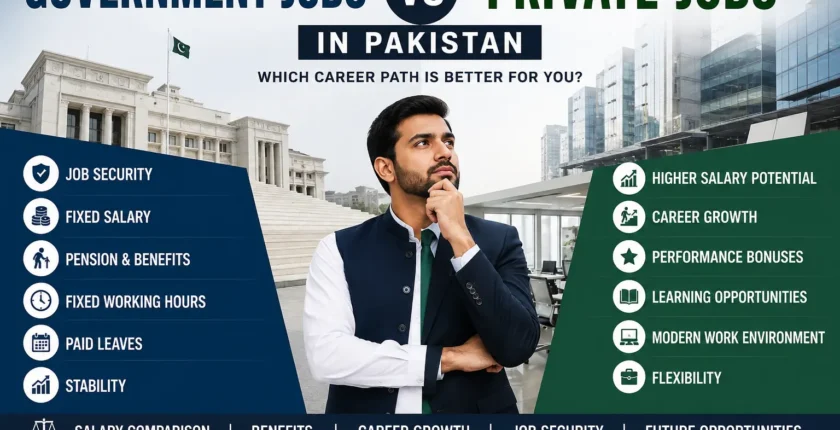
Government Jobs vs Private Jobs in Pakistan (2026 Complete Comparison)
Introduction
Choosing between a government job and a private job is one of the biggest career decisions for job seekers in Pakistan. Every year, thousands of graduates, experienced professionals, and fresh candidates wonder whether they should prepare for competitive government exams or apply for private sector opportunities.
Both career paths offer unique advantages and challenges. Government jobs provide stability, pensions, and long-term security, while private jobs often offer higher salaries, faster promotions, and opportunities to work with modern technologies.
Before applying, read our complete guide on How to Apply for Government Jobs in Pakistan to understand the application process and improve your chances of success.
In this guide, we’ll compare government jobs vs private jobs in Pakistan based on salary, job security, career growth, work-life balance, benefits, and future opportunities to help you make the right career choice.
What Are Government Jobs?
Government jobs are positions offered by federal, provincial, and local government departments. Employees work under government regulations and receive salaries according to official pay scales.
Popular government employers include:
- Federal Public Service Commission (FPSC)
- Punjab Public Service Commission (PPSC)
- Sindh Public Service Commission (SPSC)
- Khyber Pakhtunkhwa Public Service Commission (KPPSC)
- Balochistan Public Service Commission (BPSC)
- Pakistan Army
- Pakistan Navy
- Pakistan Air Force
- Police Departments
- WAPDA
- NADRA
- Pakistan Railways
- State Bank of Pakistan
- Public Universities
What Are Private Jobs?
Private jobs are offered by privately owned companies, startups, multinational corporations (MNCs), software houses, banks, manufacturing industries, educational institutions, hospitals, and e-commerce businesses. Most recruiters also review LinkedIn profiles, so learning How to Create a Professional LinkedIn Profile can increase your chances of getting shortlisted.
Common private employers include:
- IT companies
- Software houses
- Banks
- Telecom companies
- Manufacturing industries
- Digital marketing agencies
- E-commerce companies
- Healthcare organizations
- Educational institutes
- Multinational companies
Government Jobs vs Private Jobs: Detailed Comparison
| Feature | Government Jobs | Private Jobs |
|---|---|---|
| Job Security | Very High | Moderate |
| Salary | Fixed Pay Scale | Performance-Based |
| Promotions | Seniority Based | Performance Based |
| Pension | Available (many departments) | Usually Not Available |
| Medical Benefits | Excellent | Depends on Company |
| Annual Leaves | More | Company Policy |
| Working Hours | Fixed | May be Flexible or Extended |
| Career Growth | Slow | Fast |
| Bonuses | Limited | Performance Bonuses |
| Technology Exposure | Moderate | High |
| Innovation | Limited | High |
| Competition | Very High | Moderate |
1. Job Security
One of the biggest reasons Pakistanis prefer government jobs is job security.
Government employees rarely lose their jobs unless serious misconduct occurs. Even during economic downturns, government departments continue operating.
Private companies, however, may reduce staff due to financial losses, restructuring, or changing business needs.
Winner:
Government Jobs
2. Salary Comparison
Many people believe government jobs always pay better, but this isn’t always true.
Government salaries follow official pay scales, and increments are fixed.
Private companies may offer:
- Higher starting salaries
- Annual bonuses
- Performance incentives
- Sales commissions
- Project bonuses
Professionals in software development, digital marketing, finance, engineering, and management often earn significantly more in the private sector.
Winner:
Private Jobs
3. Career Growth
Government promotions usually depend on:
- Seniority
- Vacant positions
- Department policies
- Time served
Private companies reward:
- Skills
- Performance
- Certifications
- Leadership
- Results
Talented employees may receive promotions within a few years.
Winner:
Private Jobs
4. Work-Life Balance
Government offices generally have:
- Fixed office timings
- Public holidays
- Paid leave
- Better work-life balance
Private companies may require:
- Overtime
- Weekend work
- Tight deadlines
- Shift duties
However, many modern companies now offer hybrid and remote work options.
Winner:
Government Jobs
5. Employee Benefits
Government employees often receive:
- Pension (in many departments)
- Medical facilities
- House rent allowance
- Travel allowance
- Utility allowance
- Paid maternity leave
- Annual leave
- Provident fund
Private companies vary widely. Large multinational companies often provide the following:
- Health insurance
- Annual bonuses
- Performance incentives
- Paid training
- Gym memberships
- Remote work options
Winner:
Government Jobs (overall)
6. Learning Opportunities
Private organizations constantly adopt:
- AI technologies
- Cloud computing
- Digital marketing
- Cybersecurity
- Automation
- Modern software
Employees gain valuable skills that improve their future career prospects.
Government departments generally change more slowly.
Winner:
Private Jobs
7. Competition
Government vacancies often receive thousands of applications for a single position.
Private companies also receive many applications, but hiring is more frequent throughout the year.
Winner:
Private Jobs
8. Job Stability During Economic Crisis
Government departments continue functioning regardless of market conditions.
Private businesses may experience:
- Hiring freezes
- Budget cuts
- Layoffs
- Downsizing
Winner:
Government Jobs
9. Performance Pressure
Government employees generally experience lower performance pressure.
Private sector professionals often work with:
- KPIs
- Monthly targets
- Client deadlines
- Performance reviews
Winner:
Government Jobs
10. International Career Opportunities
Experience gained in multinational companies often helps professionals secure overseas employment.
Private-sector skills are highly transferable across industries and countries. Graduates can explore educational resources from the Higher Education Commission (HEC) to plan their careers.
Government experience is usually more department-specific.
Winner:
Private Jobs
Pros and Cons of Government Jobs
Advantages
- Excellent job security
- Fixed working hours
- Pension benefits
- Medical facilities
- Paid leaves
- Housing and travel allowances
- Respect in society
- Stable career
Disadvantages
- Slow promotions
- Lower salary growth
- Limited innovation
- Bureaucratic environment
- Highly competitive recruitment
Pros and Cons of Private Jobs
Advantages
- Higher salary potential
- Faster promotions
- Performance bonuses
- Modern work environment
- Better learning opportunities
- International exposure
- Skill development
- Flexible work options in many companies
Disadvantages
- Less job security
- Higher work pressure
- Longer working hours
- Limited leave in some organizations
- Layoff risks
Who Should Choose Government Jobs?
Government jobs are ideal if you:
- Want long-term stability
- Prefer fixed office timings
- Value pension and retirement benefits
- Like structured career progression
- Prefer lower workplace stress
- Plan for a secure family life
Who Should Choose Private Jobs?
Private jobs are suitable if you:
- Want rapid career growth
- Enjoy learning new technologies
- Are comfortable with competition
- Aim for higher income
- Prefer performance-based promotions
- Want international opportunities
Can You Switch Between Government and Private Jobs?
Yes. Many professionals move from the private sector to government service after passing competitive examinations. Likewise, government employees sometimes transition to private companies for better salaries and career advancement.
The key is to continue developing your skills, earning certifications, and building relevant experience.
Tips for Choosing the Right Career
Before deciding, ask yourself:
- Do I value job security or rapid growth?
- Am I comfortable with performance-based work?
- What are my long-term financial goals?
- Do I prefer a structured environment or a fast-paced workplace?
- Which field matches my skills and interests?
- What lifestyle do I want in the next 10 years?
Your answers will help determine which path aligns best with your personal and professional goals.
Frequently Asked Questions (FAQs)
Which is better: government or private jobs in Pakistan?
Neither is universally better. Government jobs offer stability and benefits, while private jobs generally provide faster career growth, higher earning potential, and greater exposure to modern technologies.
Do government jobs pay more than private jobs?
Not always. Senior government positions can be well paid, but skilled professionals in IT, banking, engineering, finance, and multinational companies often earn significantly higher salaries in the private sector.
Are government jobs more secure?
Yes. Government jobs are generally considered the most secure employment option in Pakistan due to stable contracts and strong employment protections.
Is career growth faster in private companies?
Yes. Promotions in the private sector are usually based on performance, skills, and results rather than seniority, allowing employees to advance more quickly.
Can fresh graduates apply for both government and private jobs?
Absolutely. Fresh graduates should explore both sectors to maximize opportunities and choose the path that best matches their skills, interests, and career goals.
Final Thoughts
The debate between government jobs vs private jobs in Pakistan has no one-size-fits-all answer. Government jobs are an excellent choice for those seeking long-term stability, retirement benefits, and predictable work schedules. On the other hand, private jobs are ideal for individuals who prioritize rapid career advancement, competitive salaries, and continuous skill development.
Evaluate your priorities, strengths, and long-term goals before making a decision. Whether you choose the public or private sector, staying updated with industry trends, improving your skills, and applying consistently will increase your chances of building a successful career.