
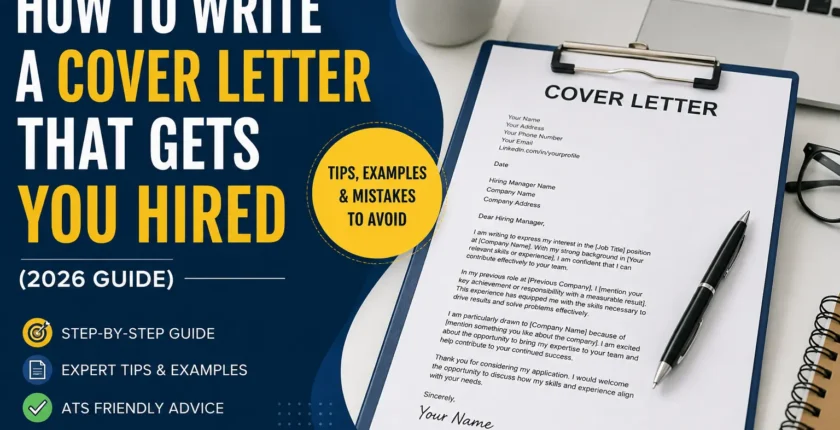
How to Write a Cover Letter That Gets You Hired (2026 Guide)
Introduction
When applying for a job, many candidates spend hours perfecting their CV but overlook one important document: the cover letter. A strong cover letter can significantly increase your chances of getting an interview by showing employers why you’re the right fit for the role. Before writing your cover letter, make sure your CV is professionally written. Read our guide on How to Write a CV for Jobs in Pakistan (2026 Guide).
Whether you’re a fresh graduate, an experienced professional, or looking for remote opportunities, learning how to write a cover letter that gets you hired is an essential career skill.
In this complete 2026 guide, you’ll learn the purpose of a cover letter, the correct format, expert writing tips, common mistakes to avoid, and a professional cover letter example.
What Is a Cover Letter?
If you’re still searching for opportunities, our guide on How to Find a Job Online in Pakistan can help you discover trusted job websites. A cover letter is a one-page document submitted alongside your CV or resume when applying for a job. It introduces you to the employer, explains why you’re interested in the position, and highlights your most relevant skills and achievements.
Unlike your CV, which lists your qualifications and work history, a cover letter tells your professional story and explains why you’re the best candidate.
Why Is a Cover Letter Important?
Many employers still expect applicants to include a cover letter. A well-written cover letter can:
- Create a strong first impression.
- Show your communication skills.
- Demonstrate genuine interest in the company.
- Explain career changes or employment gaps.
- Highlight achievements not fully covered in your CV.
- Increase your interview chances.
Recruiters often spend only a few seconds reviewing each application. A compelling cover letter encourages them to continue reading your CV.
When Should You Include a Cover Letter?
Always include a cover letter when:
- The employer specifically requests one.
- Applying through company websites.
- Applying via LinkedIn or job portals.
- Sending applications by email.
- Applying for internships.
- Applying for graduate programs.
- Applying for remote jobs.
- Applying for international opportunities.
Even when it’s optional, submitting a professional cover letter shows initiative.
Standard Cover Letter Format
A professional cover letter should follow this structure:
1. Contact Information
Include:
- Your Name
- Phone Number
- Professional Email
- LinkedIn Profile (optional)
- City, Country
2. Date
Write the current application date.
3. Employer Information
Include:
- Hiring Manager’s Name
- Company Name
- Company Address
Search for jobs and connect with recruiters on LinkedIn. If you don’t know the hiring manager’s name, that’s okay.
4. Professional Greeting
Examples:
- Dear Hiring Manager,
- Dear Recruitment Team,
- Dear HR Manager,
Avoid outdated greetings like the following:
- To Whom It May Concern
5. Opening Paragraph
Immediately grab attention by mentioning:
- Position you’re applying for
- Where you found the job
- Why you’re interested
Example:
I am excited to apply for the Digital Marketing Executive position at your company. With experience in SEO, content marketing, and campaign management, I am confident I can contribute to your growing team.
6. Middle Paragraph
Explain:
- Your experience
- Skills
- Achievements
- Certifications
- Projects
Instead of listing responsibilities, show measurable results.
Example:
Instead of saying
“I managed social media.”
Say:
“I increased Instagram engagement by 65% within six months through targeted content strategies.”
Numbers make your achievements more credible.
7. Why You Want This Job
Recruiters want to know why you chose their company.
Mention:
- Company values
- Mission
- Products
- Culture
- Career growth opportunities
Keep it genuine.
8. Closing Paragraph
End confidently.
Example:
Thank you for considering my application. I would welcome the opportunity to discuss how my skills and experience can contribute to your team. I look forward to hearing from you.
9. Professional Closing
Use:
- Sincerely,
- Best Regards,
- Kind Regards,
Then write your full name.
Cover Letter Example
Dear Hiring Manager,
I am writing to express my interest in the SEO specialist position at your company. With over two years of experience in search engine optimization, link building, keyword research, and content strategy, I have helped businesses improve organic traffic and online visibility.
In my previous role, I successfully managed SEO campaigns that increased website traffic by more than 80% within eight months. I am experienced with Google Search Console, Google Analytics, Ahrefs, SEMrush, and WordPress SEO optimization.
I admire your company’s commitment to innovation and customer satisfaction. I believe my analytical mindset and passion for digital marketing would allow me to make a valuable contribution to your team.
Thank you for considering my application. I look forward to discussing how I can support your organization.
Sincerely,
Your Name
Tips to Write a Cover Letter That Gets You Hired
Customize Every Cover Letter
Never send the same letter to every employer.
Tailor it according to:
- Job description
- Required skills
- Company values
- Industry
Keep It Short
The ideal cover letter is between 250 and 400 words.
Recruiters prefer concise applications.
Use Keywords
Many companies use Applicant Tracking Systems (ATS).
Include keywords from the job description naturally.
Examples:
- Project Management
- Customer Service
- SEO
- Data Analysis
- Software Testing
- Python
- Digital Marketing
Focus on Results
Recruiters care more about achievements than responsibilities.
Use numbers whenever possible.
Example:
- Reduced processing time by 30%
- Increased sales by 45%
- Improved customer satisfaction to 98%
Match Your Tone
Be professional but conversational.
Avoid overly formal language that sounds robotic.
Proofread Carefully
Check for:
- Grammar mistakes
- Spelling errors
- Incorrect company names
- Formatting issues
One typo can create a poor first impression.
Common Cover Letter Mistakes
Avoid these common errors:
- Using the same letter for every application.
- Repeating your CV word for word.
- Making the letter too long.
- Using informal language.
- Including irrelevant personal information.
- Focusing only on what you want instead of how you can help the employer.
- Forgetting to proofread.
Cover Letter Tips for Fresh Graduates
If you have little or no work experience, focus on:
- University projects
- Internships
- Volunteer work
- Certifications
- Soft skills
- Leadership activities
Employers understand that graduates are just starting their careers.
Cover Letter Tips for Experienced Professionals
Highlight:
- Years of experience
- Leadership roles
- Major achievements
- Industry expertise
- Awards
- Professional certifications
Demonstrate how your experience can solve the employer’s problems.
ATS-Friendly Cover Letter Tips
To improve compatibility with Applicant Tracking Systems:
- Use a simple layout.
- Avoid tables and graphics.
- Use standard fonts.
- Include relevant keywords.
- Save as PDF if requested.
- Keep formatting clean and readable.
Learn more about digital hiring practices from Google.
Final Thoughts
A well-written cover letter is more than just an introduction; it’s your opportunity to convince employers that you’re the ideal candidate before they even open your CV. You can also explore more career advice and job search resources in our career blog.
By customizing each cover letter, highlighting measurable achievements, and keeping your writing concise and professional, you’ll greatly improve your chances of landing interviews in today’s competitive job market.
Take the time to personalize every application, and you’ll stand out from candidates who rely on generic templates.
Frequently Asked Questions (FAQs)
Do I need a cover letter for every job application?
Yes. Even if it’s optional, including a tailored cover letter demonstrates professionalism and increases your chances of getting noticed.
How long should a cover letter be?
A cover letter should typically be between 250 and 400 words, fitting comfortably on one page.
Can I use the same cover letter for multiple jobs?
It’s best to customize your cover letter for each role by matching the employer’s requirements and company values.
Should fresh graduates write a cover letter?
Absolutely. Fresh graduates can highlight internships, academic projects, certifications, volunteer work, and transferable skills to make a strong impression.
What is the difference between a CV and a cover letter?
A CV summarizes your education, experience, and skills, while a cover letter explains why you’re interested in the role and how your qualifications make you the best fit.
Comments are closed.